Domper
Saludos.
Respecto a la movilidad en motos, lo que denota es que se carece de vehículos blindados de transporte, que es la solución contra la artillería, sea convencional, con drones o con catapultas.
En teoría los rusos deberían tener más o menos la misma cantidad de blindados en el frente con la que empezaron la guerra, de menor calidad eso sí pero en cantidades similares. Si Rusia utiliza menos AFV y APC no es porque no los tenga, es porque piensa que que gastar soldados es más rentable que perder esos blindados.
Finalmente, sobre lecciones de tácticas de los rusos, permítame que me ría un poco. Con un frente que supera los dos mil kilómetros, siguen empecinados en prolongadas batallas por aldeas, para ganar unos pocos metros. Lo que hicieron los ucranianos en Kursk podrían hacerlo los rusos, pero no. Lo dicho, lecciones, pocas. Encima hablan de la experiencia de campañas anteriores ¿De la Gran Guerra?
Rusia si ha ido cambiando sus tácticas, empezaron la guerra utilizando BTG (battalion tactical group) como unidad de maniobra.
https://en.wikipedia.org/wiki/Battalion_tactical_group
In August 2021, Russia's defence minister said the country had about 170 BTGs. Each BTG has approximately 600–800 officers and soldiers, of whom roughly 200 are infantrymen, equipped with vehicles typically including roughly 10 tanks and 40 infantry fighting vehicles.
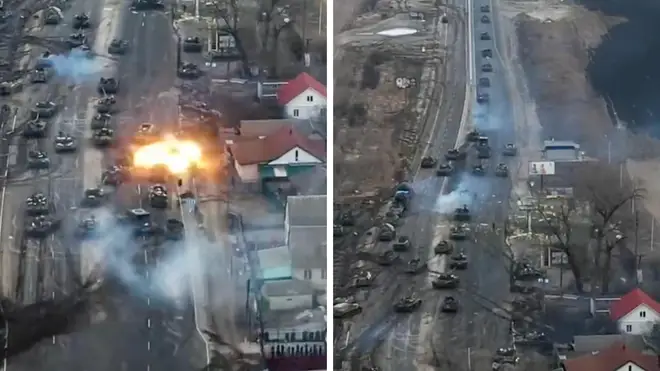
Los BTG fracasaron excepto en el sur y hoy usualmente ya no operan de forma independiente, imágenes de columnas así hoy en día son impensables.
El siguiente PDF es una compilación del US Army sobre la doctrina rusa de sus fuerzas terrestres o Sukhopútnye Voyská SV, desde operaciones con armas nucleares tácticas, uso de fuerzas especiales, hasta integrar la defensa aérea o reconocimiento con drones, toda tarea que puede desempeñar el SV esta detallada aquí.
Russian Tactics
chrome-extension://efaidnbmnnnibpcajpcglclefindmkaj/
https://g2webcontent.z2.web.core.usgovc ... eb2024.pdf
Pero una cosa es lo que se dice en teoría y otra la práctica. Si el ejército ruso lucha por cada aldea atacando a lo largo de todo el frente en lugar de un esfuerzo concentrado por romper el frente y operar en la profundidad de los ucranianos, no es porque no quieran, sino porque no pueden. Toda la doctrina rusa en el capítulo sobre "Ataques" tiene ejemplos de "operaciones profundas" y como romper el frente utilizando fuerzas escalonadas.
"7-22. The SV senior commander at the brigade, division, and army levels plan the offensive in two echelons as shown in figure 7-1 on page 7-6. In the offense, the first echelon is a combined arms force composed of one-half to two-thirds of the available combat power sufficient to find, fix, and destroy the first echelon aggressor units. The first echelon conducts the main attack to achieve the immediate mission objective set by the next higher level typically oriented on an aggressor unit.
7-23. The second echelon correspondingly has one-half to one-third of the available combat power with a specific mission objective as opposed to a reserve's mission. The reserve executes emerging missions directed by the commander as the battle develops. The second echelon may reorient from the original attack plan to take advantage of the first echelon's success in creating gaps or breaches in the aggressor defenses. The second echelon mission objective is usually oriented on penetrating an aggressor unit to strike into the depth and destroy C2, support, or reserves. Its mission remains the same even when taking the initiative to exploit success.
7-24. First echelon units attacking in the main direction receive a significant artillery allocation to accomplish mission objectives. As an example, a brigade on the main attack axis may receive reinforcement of 2 to 4 additional artillery battalions from the AAG.
7-25. Precision missile, long-range multiple rocket launchers (MRL), and aerospace strikes controlled by the Army commander hit key aggressor targets such as bridges, airfields, and aggressor reserves. These strikes support not only army objectives but also tactical-level offensive actions by integration within the Army commander's plan.
Meatgrinder: Russian Tactics in the Second Year of Its Invasion of Ukraine
El documento es de Royal United Services Institute RUSI publicado en 2024 explica el cambio en las tácticas rusas entre 2022 y 2023. En su momento ya lo puse en el foro pero otra vez no hace daño.
chrome-extension://efaidnbmnnnibpcajpcglclefindmkaj/
https://static.rusi.org/403-SR-Russian- ... -final.pdf
"How Russia Fights"
Y finalmente un estudio del Foreign Military Studies Office del US Army sobre como lucha Rusia en su guerra de conquista en Ucrania con observaciones hasta el 20 de Junio de 2024.
chrome-extension://efaidnbmnnnibpcajpcglclefindmkaj/
https://api.army.mil/e2/c/downloads/202 ... hatgpt.com
Hay multitud de innovaciones tácticas, desde adoptar en todo el frente los ataques de pequeños grupos de infantería que empezó Wagner en la toma de Bakhmut, el duo Orlan-Lancet para tareas de contrabatería, el uso de drones FPV con fibra óptica, la conversión de bombas FAB-500 en bombas planeadoras guiadas con kits de conversión UMPK que es hoy la forma de CAS más común del ejército ruso, etc.
Pero la infantería rusa esta en un proceso de degradación del que no se ve como van a salir, al menos en el corto plazo.
Russian attacks after Avdiivka, although successful, mostly devolved into undermanned, poorly trained, and poorly equipped formations slogging deeper into Ukraine a few hundred meters at a time, one daylight frontal assault after the next, with little or no tactical sophistication. Typically, these attacks followed relentless, well-placed FPV drone and artillery preparatory fires but also faced equally effective UAF countereffects. Overall, the real reason for Russia’s continued success and its ability to maintain the initiative was that the UAF were in much worse shape.
(falta de infantería ucraniana principalmente)
After Avdiivka in February 2024, there were brigade-sized RF VDV and Naval Infantry strategic movements to counter emerging dilemmas in northern Kharkiv Province and Kursk Oblast, but not maneuver warfare. Sophisticated Russian tactical and operational fires were sometimes noticeable at the front, when they temporarily interrupted UAF fires, supply, and C2.
Russian maneuver at all levels devolved to unsophisticated daylight, frontal attacks. At their highest complexity, some of these attacks were part of envelopments of small Ukrainian towns. At tactical levels, this was no doubt because of earlier significant losses of Russian junior officer leadership, losses further exacerbated by the Russians’ absence of NCOs. (There are sergeant ranks in the Russian military, but these sergeants are not NCOs and have no formal leadership roles, authority, or specialized NCO training.)








 . Saludos cordiales.